Following the temporary ceasefire in the US–Iran conflict, the Strait of Hormuz remains effectively constrained, keeping oil flows disrupted and prices elevated; however, markets increasingly expect a gradual easing of geopolitical risks. With transit still restricted, US crude exports surged, exceeding 250 million barrels over nine weeks, reclaiming its position as the world’s largest exporter, surpassing Saudi Arabia. As markets became desensitized to geopolitical tensions and high oil prices, global equities rebounded in April. Nasdaq, Wind A Index, and Hang Seng Tech rose 15.29%, 1.33%, and 4.78%, respectively, with Nasdaq reaching new highs. Meanwhile, Q1 earnings have made sector trends for 2026 increasingly clear, while the incoming Fed Chair’s policy stance introduces a key macro uncertainty.
Strong Q1 earnings growth with sharp sector divergence
From a fundamental perspective, industrial profits of large enterprises rose 15.5% YoY in Q1 2026, with pronounced cross-sector divergence. New-economy sectors—AI computing, semiconductors, and non-ferrous metals—delivered strong earnings growth, with high-tech manufacturing up 47.4% and materials up 77.9%. Profits in telecom and electronic equipment, as well as non-ferrous processing, more than doubled, while traditional sectors such as autos, steel, and construction materials remained under pressure. Listed company results confirm an accelerating split between old and new growth drivers, highlighting increasingly polarized profitability across industries.
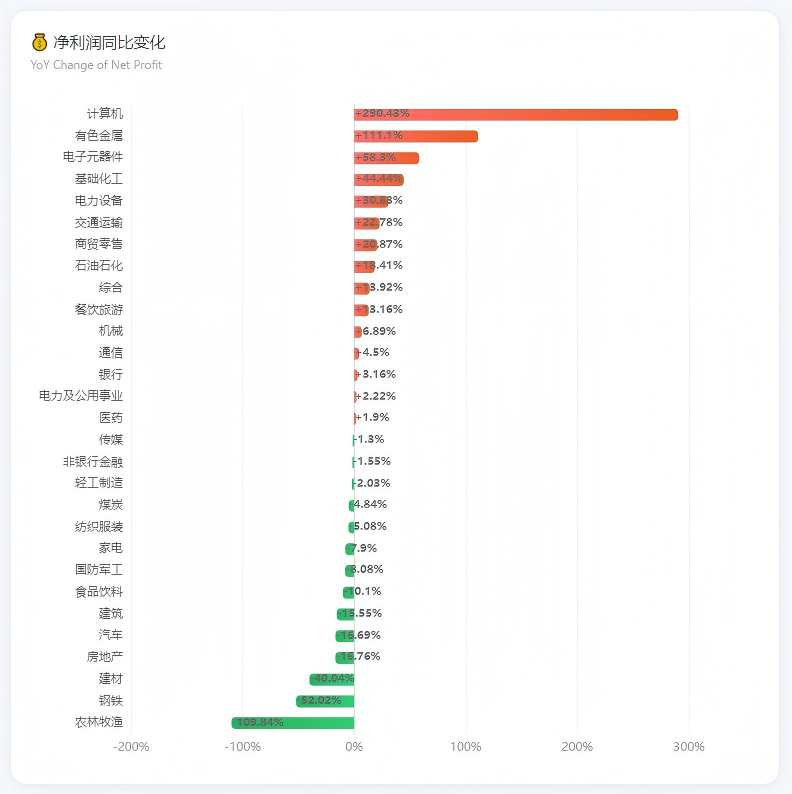
US–Iran conflict accelerates China’s exit from deflation
Despite wide sector dispersion, macro data suggest China is showing clear signs of exiting deflation. While household income and domestic demand remain soft, anti-overcapacity measures and rising oil prices are driving supply-side tightening. Midstream firms are raising prices, breaking the deflationary price spiral, with relatively strong downstream acceptance. As a result, midstream earnings recovery in 2026 appears increasingly certain.
As energy supply constraints persist, supply-demand dynamics are shifting in favor of upstream producers. Supported by a diversified power structure and high electrification in transport, China’s manufacturing sector demonstrates strong resilience, positioning it as a relative outperformer globally. In this context, some previously overcapacity midstream industries may emerge as key beneficiaries.
Equity market divergence may intensify
Following the policy-driven broad rebound beginning in September 2024, equity markets have re-entered a phase of clear divergence since the second half of 2025. Consumer-oriented and downstream sectors have weakened, with some stocks retracing to prior lows, while high-growth, high-visibility sectors continue to reach new highs. This divergence reflects improving market maturity rather than irrational dislocation, but it significantly raises the bar for stock selection and forward earnings visibility.
Many outperformers are concentrated in B2B supply chains, where order visibility and earnings forecasting are inherently more complex. Similar patterns are evident in both US and China equity leaders, with capital increasingly concentrated in top performers, suggesting that divergence and capital concentration effects are likely to persist.
What changes could Kevin Warsh bring to the Fed?
On the policy front, incoming Fed Chair Kevin Warsh is grounded in supply-side economics and maintains a structurally hawkish stance. He opposes quantitative easing and advocates balance sheet reduction alongside a stronger US dollar; his nomination has already triggered market volatility. While near-term policy will need to reflect political realities, his longer-term policy bias is likely to remain a key influence on market expectations.
Investment strategy
China A-shares remain on a gradual bull trajectory, with sentiment resilient; the recent geopolitical shock resembles a temporary correction rather than a structural shift. As tensions ease, markets are reverting to their prior trajectory. Two structural drivers—AI capex and deglobalization—continue to define sector divergence globally.
Rapid expansion in data center investment by major US tech firms is creating supply-demand imbalances across technology, power, and upstream supply chains, driving sharp earnings expansion in related sectors. Meanwhile, deglobalization is reinforcing defense spending and supply chain localization, prioritizing security over cost efficiency and further exacerbating supply-demand imbalances in upstream industries.
Strategically, maintain a pro-risk stance with active exposure to high-growth sectors, while gradually re-engaging with sectors where downside risks have been largely priced in.
Wu Weizhi
4 May 2026
本期《偉志思考》簡體中文版鏈接:
WE Think: Is This Selloff in Tech Hardware a Bull-Market Correction or a Bubble Burst?
In July 2026, global technology stocks reversed sharply, erasing a significant portion of their first-half gains. The STAR 50, ChiNext, and CSI 300 fe
2026-08-03WE Think: Super Cycle or Speculative Excess?
I recently published a book, Long-Term Wins: Navigating Bull and Bear Cycles in the Stock Market, with the help of my colleagues and the editorial te
2026-07-06WE Think: How Long Can the AI Liquidity Siphon Last? Every Bubble Peaks in a Similar Way
In May, global equity markets saw an accelerating rally in AI-related sectors, accompanied by a powerful liquidity siphon effect. South Korea, Taiwan,
2026-06-01WE Think: "Epic Wrath" or "Epic Mistake"? Don’t Underestimate the Impact of the U.S.–Iran War on Global Markets
Over the past month, global attention has focused on the Persian Gulf and the Strait of Hormuz. Since the U.S. and Israel launched a decapitation stri
2026-03-30